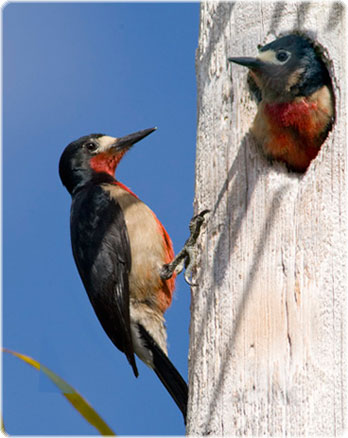
Puerto Rican Woodpecker–Clay Humphrey photography
“Just look at this list of bird's sighted right on the rainforestinn's estate.”
- Red Tailed Hawk (Guaraguao)
- Mangrove Cuckoo
- Puerto Rican Lizard-Cuckoo (Coccyzus vieilloti)
- Puerto Rican Woodpecker
- Scaly-naped Pigeon (Patagioenas squamosa)
- White-winged Dove (Zenaida asiatica)
- Green Mango: [Anthracothorax viridis] hummingbird
- Puerto Rican Emerald
- Puerto Rican Tody (San Pedrito)
- Gray Kingbird
- Pearly-Eyed Thrasher
- Red legged Thrush
- Bananaquit (Coereba flaveola)
- Cape May Warbler
- Black Throated blue warbler
- Black-Cowled Oriole
- Shiny Cowbird
- Striped Headed Tanager
- Antillean Euphonea
- Indigo Bunting
- Black-faced Grassquit (Tiaris bicolor)
- Black Whiskered Vireo
- Pin Tailed Whyoah
- Greater Antillean Oriole
- Puerto Ricon Bull Finch
- Puerto Rican Fly Catcher
- Great White Egret (Casnerodius albus)
- Black-and-White Warbler (mariatilta varia)
- American Redstart (sectophaga runticilla)
- Northern Parula (Parula americana)
- Antillean Mango (Anthracothorax dominicus)
- Puerto Rican Tanager (Nesospingus speculiferus)
- Puerto Rican Screech Owl (otus nudipes)
- White-crowned Pigeon (Columba leucocephala)
Puerto Rican Tody or "San Pedrito"
– Photo: G. Beaton
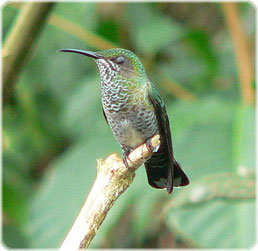
Green Mango Hummingbird taking a short nap – Photo: Jean Bridgman
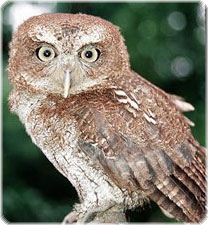
Puerto
Rican Screech Owl Megascops nudipes
Múcaro, Autillo de Puerto Rico – Photo: M. Oberle
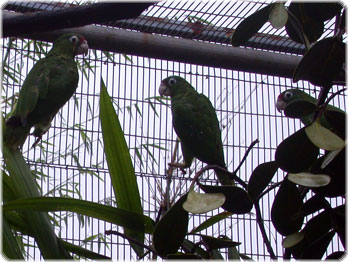
Puerto Rican Parrots at El Yunque breeding facility – Photo: William Humphrey
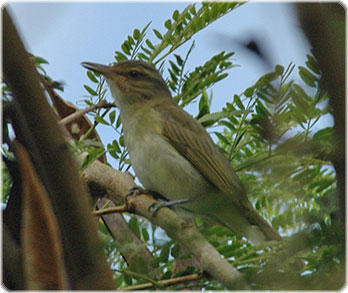
Black Whiskered Vireo (makes a pretty bird call here at the raniforest inn) |
The information and photographs on this web site come from Puerto Rico's
Birds in Photographs (Paperback) by Mark W. Oberle. This excellent book which
includes a CD-ROM of bird sounds and photographs is available at El Portal
visitor
Center in El Yunque, local Puerto Rican bookstores and Amazon.com.
My favorite bird is the Lizard-Cuckoo. I love listening to their call, and
the long striped tail reminds me of the bird drawings I used to peruse as
a child in a classic book on "Birds of Paradise".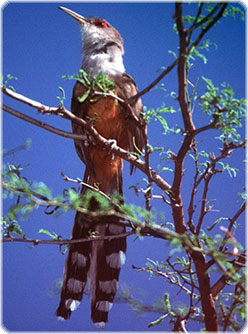
There is one that lives in the tree just behind the rainforest inn.
VOICE: The song is a rapid series of "caw" notes, commonly
described as "cow cow, kuk krrk"; also makes a variety of low-pitched
calls. Bird Call Audio (M. Oberle).
You can also hear more Puerto Rican bird calls in our Sounds
of the Rainforest Podcasts.
HABITAT: Thickets, forests, and shade coffee plantations throughout the island.
HABITS: The Puerto Rican Lizard-Cuckoo, moves slowly through vines and thickets,
foraging in the middle story and upper canopy for prey. It favors
Puerto Rico’s abundant lizards (perhaps 3/4 of its diet). In some forest
areas of Puerto Rico, lizard densities have been documented at over 4,000
lizards per acre. The Lizard-Cuckoo also eats large spiders and insects, including
cicadas, beetles, stick insects, and caterpillars. It often keeps its body
still while it twists its neck at an odd angle to strike at prey. Although
this cuckoo is a large, colorful bird, it is often difficult to see because
of its slow movements in thick foliage. However, after rains, the bird will
sometimes sit out in the open to dry off and preen. Its nest is a twig platform
in a tree or bush and contains 2-3 blue eggs.
|
The Puerto Rican Parrot
Amazona vittata
Cotorra de Puerto Rico - Parrot Call
Audio (M. Oberle)
The following information is Quoted directly from Mr. Oberle's book:
STATUS AND CONSERVATION: The Puerto Rican Parrot was formerly found on
Vieques and Culebra. It also lived on the islands of Barbuda and Antigua as
well, suggesting that this parrot ranged across the northern Lesser Antilles.
This range reduction sadly illustrates a larger pattern: in all of the West
Indies there were 50 to 60 species of endemic parrots, parakeets and macaws
at about the time humans arrived. Since then all but 12 of those have become
extinct.
The Puerto Rican Parrot was common into the nineteenth Century, with a population
of perhaps a million birds. The wild population declined to 13 individuals
by 1975, and the species is on the Federal endangered species list.
Habitat loss, hunting, and the pet trade contributed to the decline. Under
aggressive protection, the population recovered to 45-47 birds but then dropped
to 21-23 birds after Hurricane Hugo in 1989. In the two nesting seasons after
Hurricane Hugo, a record number of young were produced. Although Hurricane
Georges passed through El Yunque in 1998, the remaining wild population lived
on the western side of El Yunque in valleys that were protected from the strongest
winds. Thus, very few parrots were lost in that storm.
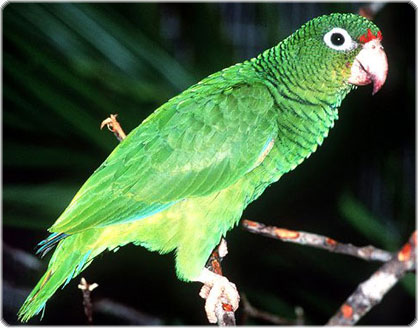 Threats to the Puerto Rican Parrot (photo: U.S. Fish & Wildlife Service)
include nest predation by Pearly-eyed Thrashers, Red-tailed Hawks and rats;
loss of nest trees and food sources after hurricanes, bot fly infestations
of young birds, and aggressive, Africanized bees taking over nest cavities.
Aircraft are required to fly more than 2,000 feet above the ground over the
Parrots’ breeding area to avoid disrupting nesting. Eventually, interbreeing
with introduced parrot species may be a problem: exotic parrots have been
seen in the current breeding area in El Yunque and near potential parrot release
sites. Conservation measures include improving natural nest cavities by deepening
them or adding drainage, or even providing artificial nest cavities. Sometimes
providing a nest box for Pearly-eyed Thrashers near a parrot nest will reduce
the chances that a thrasher will evict the parrots.
Threats to the Puerto Rican Parrot (photo: U.S. Fish & Wildlife Service)
include nest predation by Pearly-eyed Thrashers, Red-tailed Hawks and rats;
loss of nest trees and food sources after hurricanes, bot fly infestations
of young birds, and aggressive, Africanized bees taking over nest cavities.
Aircraft are required to fly more than 2,000 feet above the ground over the
Parrots’ breeding area to avoid disrupting nesting. Eventually, interbreeing
with introduced parrot species may be a problem: exotic parrots have been
seen in the current breeding area in El Yunque and near potential parrot release
sites. Conservation measures include improving natural nest cavities by deepening
them or adding drainage, or even providing artificial nest cavities. Sometimes
providing a nest box for Pearly-eyed Thrashers near a parrot nest will reduce
the chances that a thrasher will evict the parrots.
After Hurricane Georges, 3 chicks were produced in the wild in 1999, and 17
in captivity (5 in Luquillo and 12 in Río Abajo) . In contrast, in
1998, 10 chicks were produced in the wild and 14 in captivity (4 in Luquillo
and 10 in Río Abajo). The high productivity in the wild in 1998 may
reflect abundant food sources, such as Sierra Palms, that had matured a decade
after Hurricane Hugo. Female Hispaniolan Parrots are used as foster parents
to raise Puerto Rican Parrot chicks in captivity. Captive-raised Hispaniolan
Parrots were successfully released in the Dominican Republic in the late 1990s
to work out the details of how to release captive-bred parrots into the wild.
Ten captive-raised Puerto Rican Parrots were released in June 2000 into El
Yunque, to join the current wild flock. An additional 16 were released in
May 2001 and 9 in May 2002. Most of these released birds have survived. In
early 2003 the population was several dozen birds in the wild, plus 134 in
two captive populations at the Luquillo and Río Abajo aviaries. Although
only about 15 wild birds were detected in the February 2003 census, an increasing
number of sightings have been reported of Puerto Rican Parrots flying outside
the census area, including foraging for food on private land outside the National
Forest. So the wild population is almost certainly larger than the census
results suggest.
|